1 – The pain point that drives people away from Smoobu: the operational glass ceiling
Smoobu does one thing well: syncing your calendars. But when your business shifts from 'a few properties managed solo' to 'a real concierge service with owners and contractors,' you hit a wall. This first point is the most important, because it's the one that triggers the search for an alternative.
1.1: The calendar is up to date, but the ground operation isn't keeping up
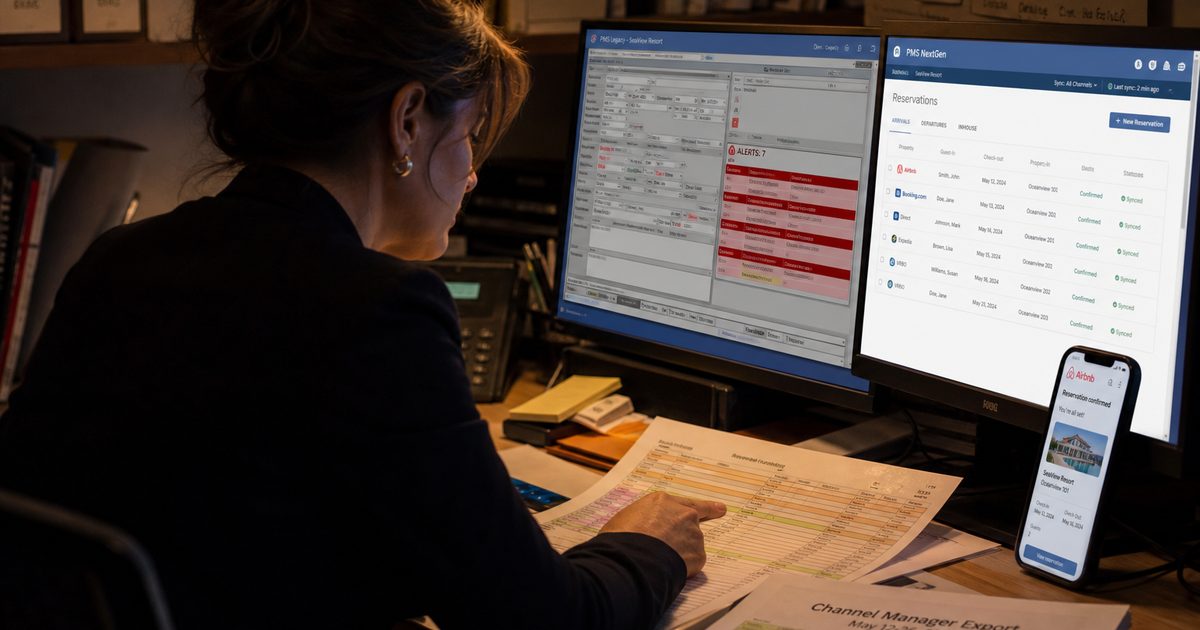
The problem is never the calendar. The calendar, Smoobu syncs. The problem is everything that doesn't appear in the calendar: the cleaning between two stays, the linen to be delivered, the access code to send, the owner who wants to know how much they earned in June.
When you manage 5 properties, you compensate with your phone. At 15, you can't anymore. You spend your mornings sending WhatsApp messages to contractors, copying figures into a spreadsheet for owners, checking that the cleaning was done before the 4pm arrival.
Smoobu doesn't cover these tasks. That's not a flaw — it's simply outside its scope. It's a channel manager, not an operational management tool. But that gap is what drives you to look for something else.
1.2: What it costs to stay on an undersized tool
Let's do the simple maths. If your software bill goes from €80 to €280 per month because you've activated modules, added properties, and paid commissions on direct bookings, those €200 per month add up to €2,400 per year. That's the equivalent of the annual commission on a small apartment.
When you present your costs to an owner, every line matters. Software with predictable costs lets you project your margins. Software whose price changes with every tier or activated module makes your projections blurry. For a growing concierge business, cost visibility isn't a detail — it's what allows you to sign a new contract knowing you'll remain profitable.
1.3: What Smoobu does well, and what it doesn't claim to do
Let's be fair. Smoobu has real advantages for a manager just starting out. The interface is simple, it's quick to learn, and the channel manager connects to the main OTAs. The messaging system allows for basic automated responses, and a direct booking widget is included. For an owner managing 3 apartments on their own, it's a great starting point.
However, Smoobu does not offer field task management with automatic assignment, mobile checklists, and photo proof. It doesn't provide an owner portal with detailed booking statements and configurable permissions. It doesn't integrate upsells with built-in payment processing, nor does it generate automatic door codes for each booking. These aren't hidden flaws; it's simply a different scope. The question is whether that scope still aligns with your business today.
2 – What Smoobu really costs, and what Biloki costs: the comparison with no hidden modules
The price displayed on a pricing page doesn't tell you what you'll actually pay. What matters is the total cost once you've activated everything you need, including commissions. That's where the gap between Smoobu and Biloki becomes clear.
2.1: The trap of tiered pricing with add-on modules
Smoobu advertises an attractive entry price. But the pricing structure works in property tiers, and certain advanced features are reserved for higher plans or charged as extras. You start on a basic plan, then realise you need automated messaging, a direct booking widget, or a third-party integration. At each step, the price goes up.
The problem isn't that Smoobu is expensive. It's that you don't know in advance what you'll be paying in six months, once your portfolio has grown and your needs have evolved. This pricing uncertainty is one of the first frustrations that comes up when you talk to managers who've left Smoobu.
2.2: €200 more per month is one fewer owner contract
Let's do the simple maths. If your software bill goes from €80 to €280 per month because you've activated modules, added properties, and paid commissions on direct bookings, those €200 per month add up to €2,400 per year. That's the equivalent of the annual commission on a small apartment.
When you present your costs to an owner, every line matters. Software with predictable costs lets you project your margins. Software whose price changes with every tier or activated module makes your projections blurry. For a growing concierge business, cost visibility isn't a detail — it's what allows you to sign a new contract knowing you'll remain profitable.
2.3: Marc, 22 properties in Bordeaux, discovers his real bill
Marc started on Smoobu with 6 properties. The basic plan suited him. Within a year, he'd scaled to 22 properties, wanted to automate his messages, connect a dynamic pricing tool, and offer direct bookings. At each step, he discovered he had to upgrade to a higher plan or pay for an add-on. His bill tripled without him immediately noticing, because the additions crept in gradually.
What made him start comparing: when he added up his software costs for the quarter and realised he was paying more than his smallest property was generating. The tool supposed to save him time was costing him more than a management contract.
3 – Who actually coordinates the ground operation: cleaning assignments, contractors, and proof of completion
Cleaning between stays is the number-one friction point for concierge services. It's not a software issue — it's a reputation issue. A poorly cleaned apartment means a damaging review. A missed clean means a refund. The question is simple: does your software help you prevent that, or does it leave you managing everything by text?
3.1: The failed Saturday morning clean, when three check-outs happen at the same time
Saturday morning, July. Three departures at 11am, three arrivals at 4pm. Your usual contractor is sick. You need to reassign, confirm, verify it's done — all before the next guests ring the doorbell. If your software only syncs calendars, you're handling all of this by phone. You call, you chase, you hope.
This scenario plays out every week during peak season. It's not an extreme case. It's the daily reality of any concierge service with more than 10 properties. And this is precisely where Smoobu and Biloki aren't in the same league, because Smoobu was never designed to solve this problem.
3.2: A 2-star review costs more than a month of software
A 'dirty apartment on arrival' review on Airbnb means a lower ranking, slower bookings, and sometimes a 50% refund. On Booking.com, it's a cleanliness score that drags down your overall rating. A single incident can cost several hundred euros and weeks of lost visibility.
The cost of not having a field tracking system doesn't appear on any invoice. But it shows up in your reviews, your occupancy rate, and your owners' trust. When an owner sees a negative review about the cleanliness of their property, they don't blame the cleaning contractor. They blame you, the concierge. Your contract is what's on the line.
3.3: Lucie, 14 properties in Biarritz, a long bank holiday weekend in May
Lucie manages 14 properties between Biarritz and Anglet. Over the Ascension bank holiday weekend, she had 11 turnovers in two days. Previously, she used Smoobu for calendars and a WhatsApp group for contractors. The result: two missed cleans in one weekend, a contractor who cleaned the wrong apartment, and a guest who found dirty sheets.
What she was looking for wasn't a better channel manager. It was a tool that automatically creates the cleaning assignment when the booking comes in, assigns it to the right contractor, sends them a notification, and sends her back photo proof once the work is done. Not another spreadsheet to fill in — a system that runs without her having to check every line.
Un channel manager gère des calendriers. Vous gérez des gens.
Smoobu helped you get started. The question isn't whether it's good. It's whether it can still handle the work you're doing today.
If the answer is no, every passing month comes at a cost. Saturdays spent chasing down service providers. Sunday nights spent on statements. The owner calling because they can't see anything, eventually listening to the property management company next door—the one that showed them a dashboard.
Take three properties, your two service providers, and one owner. Run them on Biloki for a month, alongside your current tool. The free trial lasts 30 days, no credit card required, with onboarding included. And if you’d rather have us show you around, book a demo.