1 – Biloki or Hostaway: Which One Really Costs Less?
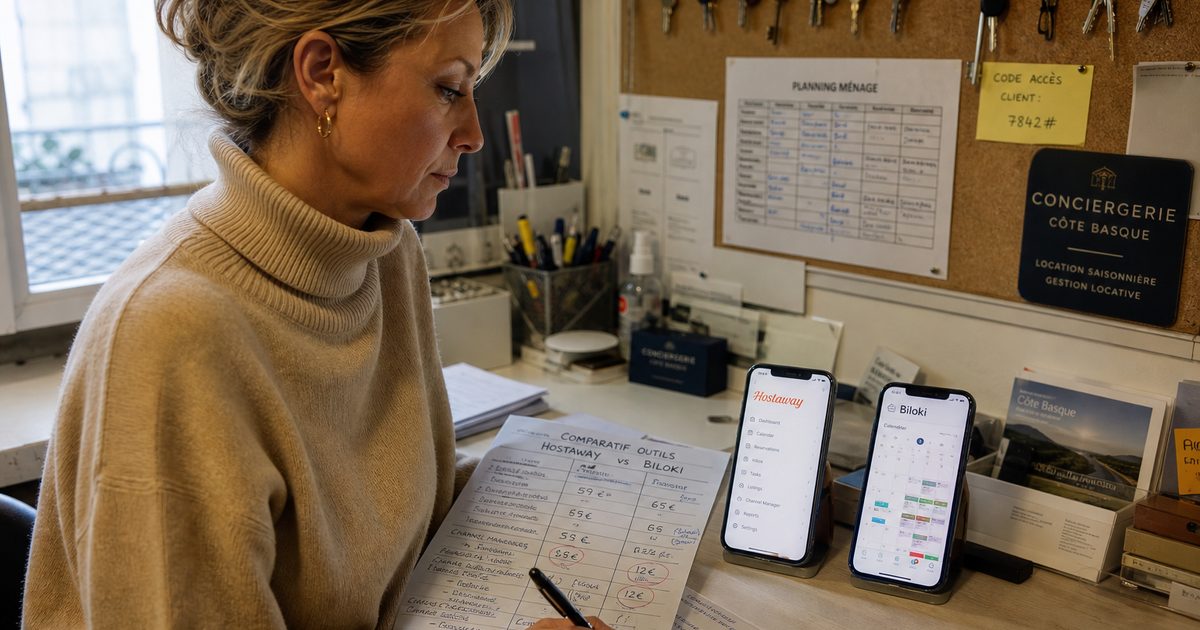
The price displayed on a pricing page tells you almost nothing. What matters is the 12-month bill, modules included, onboarding included, commission deducted. That is where Biloki and Hostaway diverge the most.
1.1: The Bill That Doubles When You Enable the "Extras"
The problem with a modular PMS is that you only discover the real price after signing. You start with a base subscription that seems reasonable. Then you activate advanced messaging, revenue management, API access, the full owner portal. Each module adds an amount. After six months, you are paying double the price announced during the demo. This is exactly the trap that managers who have already migrated once dread: choosing a tool based on its entry price, then finding yourself stuck because the essential features are all add-ons. This is not a flaw specific to Hostaway — it is the model of many international PMS platforms. But it is a criterion that clearly separates the two tools.
1.2: €200 per Year or €2,000: The Gap Is Not Trivial
A failed check-in or a sloppy cleaning is not just an operational problem. It is a public review, visible to future guests and to the owner. It is a partial refund via the platform. It is sometimes a lost management contract. On a portfolio of 20 properties with 400 turnovers per year, even 5% of failures represent 20 incidents. At an average refund of €150 and one rating point lost, the annual cost far exceeds the price difference between two PMS platforms. Yet many software solutions treat field operations as a secondary topic. Tasks exist, but execution tracking, proof of visit, per-property checklists: these are often absent or superficial.
1.3: What You Get Back by Stopping to Pay for Options
When it comes to pricing, Hostaway remains a strong contender for organizations that require its extensive ecosystem and can spread the cost across a large volume of properties. If you manage more than 100 properties and rely on dozens of third-party integrations, their modular model can be justified. However, for a property management company with 10 to 50 properties in France, Biloki’s all-in-one, no-surprises approach clearly lowers your software costs without sacrificing any essential functionality. To understand at what stage a PMS becomes more cost-effective than a stack of individual tools, read this article on the break-even point of a PMS for property management companies. Price verdict: Biloki wins for small and medium-sized property managers. Hostaway is only justified beyond 80 to 100 properties, provided you actually make use of its advanced modules.
2 – Who Really Manages Cleaning Tasks and Field Service Providers?
A PMS that synchronizes calendars is a minimum requirement. What sets two tools apart on a daily basis is what happens between the 11am check-out and the 4pm check-in. That is where properties are won or lost.
2.1: The Forgotten Cleaning on a Saturday Turnover
Every property management company has experienced this situation at least once. The guest leaves at 11am, the next one arrives at 4pm. The cleaning service provider did not receive the information, or received it by SMS the day before without confirmation. At 3:30pm, nobody has shown up. You call, you send a WhatsApp message, you hope. If the cleaning is not done, that means a two-star review, a partial refund and an unhappy owner. This scenario repeats every summer Saturday in property management companies that handle their field operations by SMS and spreadsheet. A PMS that does not cover field tasks only solves half the problem.
2.2: A Negative Review and €150 in Refunds, Every Time the Field Falls Apart
A failed check-in or a sloppy cleaning is not just an operational problem. It is a public review, visible to future guests and to the owner. It is a partial refund via the platform. It is sometimes a lost management contract. On a portfolio of 20 properties with 400 turnovers per year, even 5% of failures represent 20 incidents. At an average refund of €150 and one rating point lost, the annual cost far exceeds the price difference between two PMS platforms. Yet many software solutions treat field operations as a secondary topic. Tasks exist, but execution tracking, proof of visit, per-property checklists: these are often absent or superficial.
2.3: Sophie, 18 Properties in Annecy, on the July 14th Weekend
Sophie manages 18 properties between Annecy and Lac du Bourget. On the July 14th weekend, she has 14 turnovers. Before, she sent an Excel spreadsheet to her three service providers on Wednesday, then spent her Friday afternoons on the phone confirming visits. One forgotten property in a remote location, one key not returned properly, and the whole chain would break down. What she was looking for in a PMS was not another calendar. It was a tool that automatically creates the cleaning task as soon as a booking comes in, assigns it to the right service provider, sends them a notification with the address and checklist, and notifies her when it is done, with photo proof. That is exactly the workflow that the best field management tools offer.
3 – Which Owner Portal Helps You Retain Management Contracts?
Your owners do not see your PMS. They see what you send them. If it is an Excel spreadsheet by email once a month, they start asking questions. If it is a dedicated portal with their revenue, their reviews and their bookings in real time, they stay.
3.1: The Owner Who Calls to Find Out How Much They Earned
Every property management company knows this phone call. The owner wants to know how much they earned this month, how many nights were booked, what the latest guest review says. If you do not have an owner portal, the answer takes 20 minutes: open the spreadsheet, check the bookings, calculate the commission, write an email. Multiply that by 15 owners and you lose half a day per month in manual reporting. That is not management time. It is reassurance time. And that is exactly what a good owner portal automates.
3.2: A Lost Management Contract Is Worth More Than a Year of Subscription
An owner who lacks visibility eventually starts to doubt. Is the property management company really optimizing the price? Are the reviews good? Is the property being rented as much as promised? That doubt becomes a phone call. Then a follow-up email. Then a contract that does not get renewed. Losing an owner with two properties means losing thousands of euros in annual commissions. Transparency is not a luxury: it is a retention tool. A well-designed owner portal eliminates 80% of follow-up calls and builds trust without any additional effort.
3.3: Jean-Pierre, 4 Apartments Entrusted to a Lyon-Based Property Manager
Jean-Pierre owns four apartments in Vieux Lyon, entrusted to a local property management company. He does not handle anything day to day, but he wants to see his revenue, his reviews, and be able to adjust his prices from time to time. With his previous PMS, he received a monthly PDF. No detail per booking, no visible reviews, no way to intervene on pricing without calling the property manager. He found it opaque. His property management company migrated to a tool with a real owner portal. Jean-Pierre checks his figures whenever he wants, sees reviews in real time, and can adjust his prices within the framework defined by the property manager. He no longer calls.
Biloki or Hostaway: The Right Choice Depends on Your Portfolio
You could fill out a form, wait for a callback, sit through endless demos, and get a quote in three weeks. Or you could know by Friday.
The real cost isn't switching tools. It’s waiting. Another season of double entry, calls to check if the cleaning is done, and owner statements manually built in a spreadsheet. Fifty hours of coordination you’ll never get back.
Connect three properties. Let it run for a weekend of turnovers. Watch the tasks get created, the codes go out, and the photo reports roll in. The Biloki free trial lasts 30 days, no credit card required, with onboarding included. And if you’d rather we show you how it works, book a demo.