

1 – What a channel manager really needs to do in 2026
1.1: Calendar sync is the bare minimum
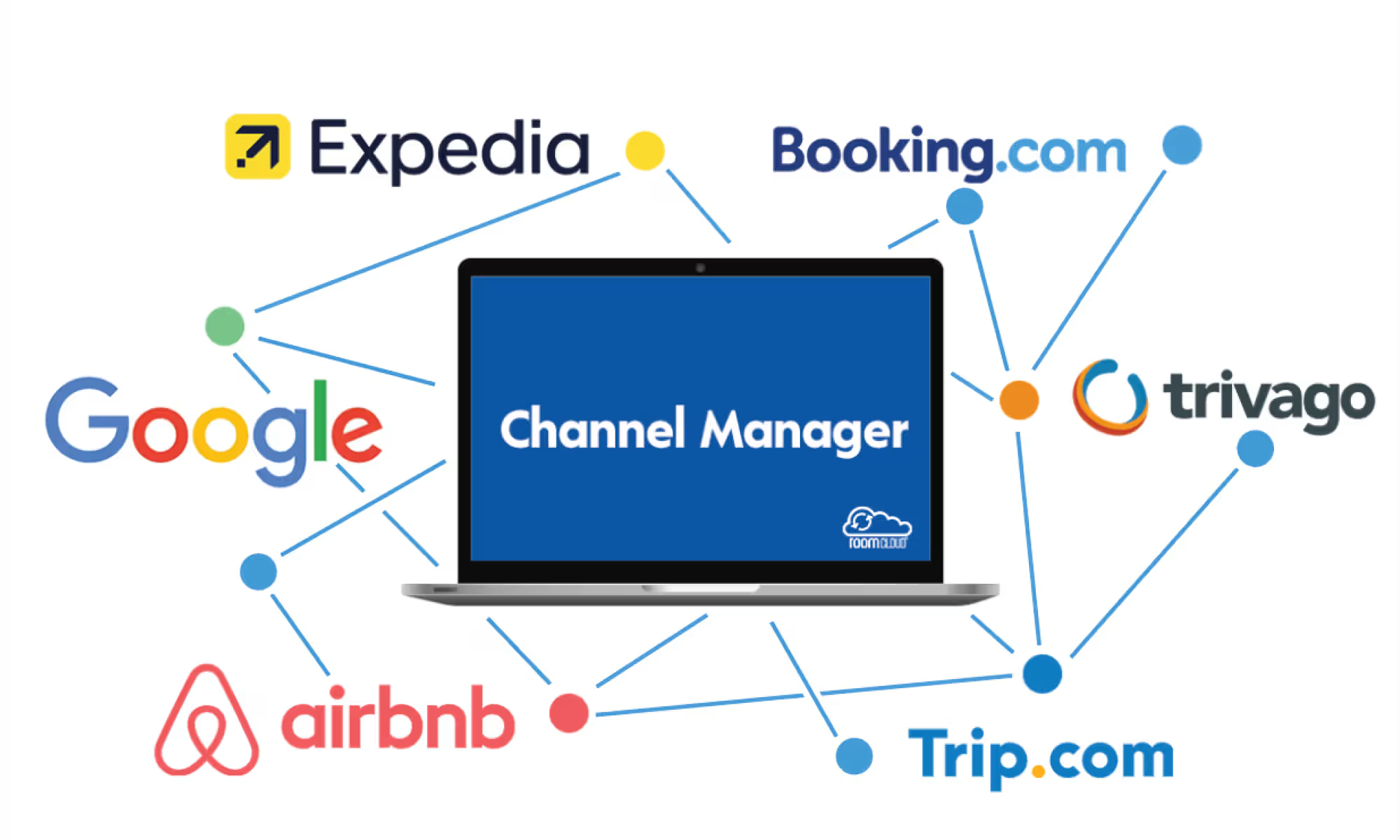
A channel manager, at its core, does one thing: it synchronizes your availability, rates, and restrictions across all the platforms where you are listed. Airbnb, Booking.com, Vrbo, Google Vacation Rentals, and sometimes niche OTAs or direct booking sites.
The problem in 2026 is no longer "does it sync." It is "how fast" and "in which direction." A tool that takes 15 minutes to push a Booking.com reservation to Airbnb leaves a 15-minute window during which another traveler can book the same property. For a highly sought-after studio in peak season, that is enough to trigger a double booking.
What you need to check: is the sync bidirectional in real time, or does it run on intervals (every 10, 15, or 30 minutes)? Some tools advertise "real time" but actually process through queues. That is where the difference lies. If you want to understand the full mechanism behind these incidents, see our guide to double bookings.
1.2: What it costs when the sync fails
1.3: Platform coverage, beyond Airbnb and Booking
In 2026, limiting yourself to Airbnb and Booking means leaving revenue on the table. Google Vacation Rentals is capturing a growing share of direct traffic. Specialized OTAs (Holidu, Likibu, HomeToGo) generate volume in certain areas. And if you operate in international markets, platforms like Vrbo or Agoda matter.
What sets a serious channel manager apart: the number of native API connections (not iCal integrations, which are slow and error-prone). A tool connected to 120+ platforms via direct API is in a completely different league from one that handles 10 OTAs natively and the rest via iCal.
Another often-overlooked point: the ability to manage distribution to direct booking channels. A good channel manager must also power your own booking site, commission-free. That is where your margins are built. If your tool limits you to third-party platforms, it costs you more than it earns you.
2 – The criteria that separate a good tool from a gimmick
2.1: Standalone channel manager or integrated PMS — the real choice
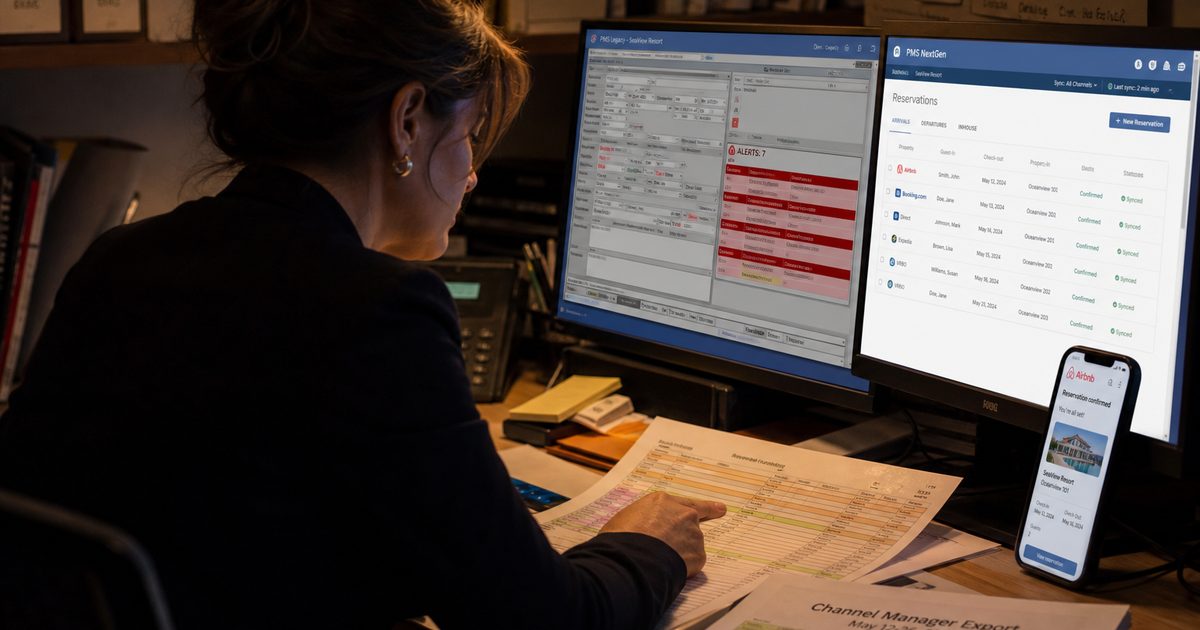
Here is the classic trap. You pick a high-performing channel manager for distribution. Then you add a separate PMS to manage your reservations. Another tool for invoicing. A spreadsheet for the cleaning schedule. An app for the locks. And you spend your days pushing information between five pieces of software that do not talk to each other.
The result: data entry errors, duplicate information, missed updates. A cleaning job not scheduled because the PMS reservation never made it into your planning tool. An active door code for a stay that was cancelled.
In 2026, the number one criterion is native integration. A channel manager that is part of a unified PMS (reservations, planning, revenue, guest communication, property access) eliminates these friction points. There is only one source of truth. When a booking comes in, everything triggers automatically. This is exactly what our article on automation workflows for property management.
2.2: Access management — the blind spot in every comparison
2.3: Integrated guest communication — not an option
A guest books on Booking. They ask a question about parking via the Airbnb messaging system (because they also saw the listing there). Another sends a WhatsApp at 2 AM asking for the WiFi code. A third wants to modify their dates by email.
If your channel manager does not centralize these exchanges, you spend your day juggling five inboxes. And you miss messages. A missed message means a negative review or a lost booking.
The right tool in 2026 integrates a unified messaging system with, ideally, an AI assistant capable of answering recurring questions (access, WiFi, checkout time, local recommendations). The measured result: up to 70% fewer manual messages. This isn't just about convenience. It's about reclaiming time to focus on what really pays off: acquiring new properties, optimizing pricing, and managing owner relationships.
3 – How to decide concretely in 2026
3.1: The questions to ask before signing
Forget feature comparison grids. Ask these specific questions to every vendor:
What is the actual propagation delay for a reservation between two OTAs? Ask for logs, not promises. How many native API connections, and how many via iCal? What happens in the event of a booking conflict: real-time alert, automatic block, or nothing? Are the PMS, messaging and access management native or through third-party integrations? What is the real cost per property per month, including all the modules you need to run your operation?
A vendor who dodges the question on sync delay or who splits every feature into a paid add-on will cost you more in practice. Always test under real conditions, on your own portfolio, with your own platforms. A free 14-day trial without a credit card is the minimum for a serious evaluation.
3.2: The case of a manager who switched tools mid-season
3.3: Regulatory compliance — the criterion you forget until the fine arrives
In 2026, with the stricter enforcement of the Le Meur Law, your channel manager must also help you stay compliant. The registration number must appear on every listing. Nightly limits (90 days for primary residences in certain cities) must be tracked automatically. Reporting to platforms must be traceable.
A channel manager that doesn't handle these constraints leaves you to face the risk alone. And fines are no longer just theoretical: several thousand euros per violation, with inspections increasing in high-demand areas.
The right tool integrates nightly tracking per property, automatic display of the registration number on listings, and alerts when you approach a regulatory threshold. This isn't a bonus. In 2026, it's a basic feature. If your current channel manager doesn't do this, you are carrying that risk alone, every single day. And the requirements aren't going to get any easier.
Is your channel manager working for you, or are you working for it?
A channel manager in 2026 is no longer a calendar sync tool. It is the nerve center of your operation. If it only handles distribution, you compensate with time, stress and errors. If it is integrated into a complete PMS (access, cleaning, messaging, compliance), it runs your concierge service while you focus on what generates revenue.
Every week you stay on a flaky tool, you lose hours, risk double bookings, and expose yourself to fines. The cost of inaction is measurable.
Biloki connects 120+ platforms in real time, and integrates PMS, smart locks, AI messaging and regulatory tracking in one place. Try it free for 14 days. You will see the difference within the first week.


