
🎉 Get 20% off with an annual plan 📱 Free onboarding and 24/7 support ✨ 1-month free trial with no credit card 🎉 Get 20% off with an annual plan 📱 Free onboarding and 24/7 support ✨ 1-month free trial with no credit card 🎉 Get 20% off with an annual plan 📱 Free onboarding and 24/7 support ✨ 1-month free trial with no credit card
Related articles
Guide
20 January 2026
8 min

Channel Manager: the complete guide to eliminating double bookings

Friday night, 10 PM. Two bookings come in at the same time for the same apartment. One via Airbnb, the other via Booking. Two different guests, same dates, same property. You discover the duplicate the next morning. You have to cancel one of them, absorb the penalty, deal with the unhappy guest, and watch your ranking drop on the platform in question. If you manage more than three properties across multiple OTAs, you've already been through this. Maybe several times. And every time, the cost is the same: time, money, a lower rating, a guest who leaves a scathing review. The problem isn't multi-platform distribution. It's the absence of reliable synchronization between your calendars. That's exactly what a channel manager solves. This guide is written for concierge managers and multi-property owners who want to understand how a channel manager works, what it concretely fixes, and how to choose the right one. No abstract theory. Real-world insights.
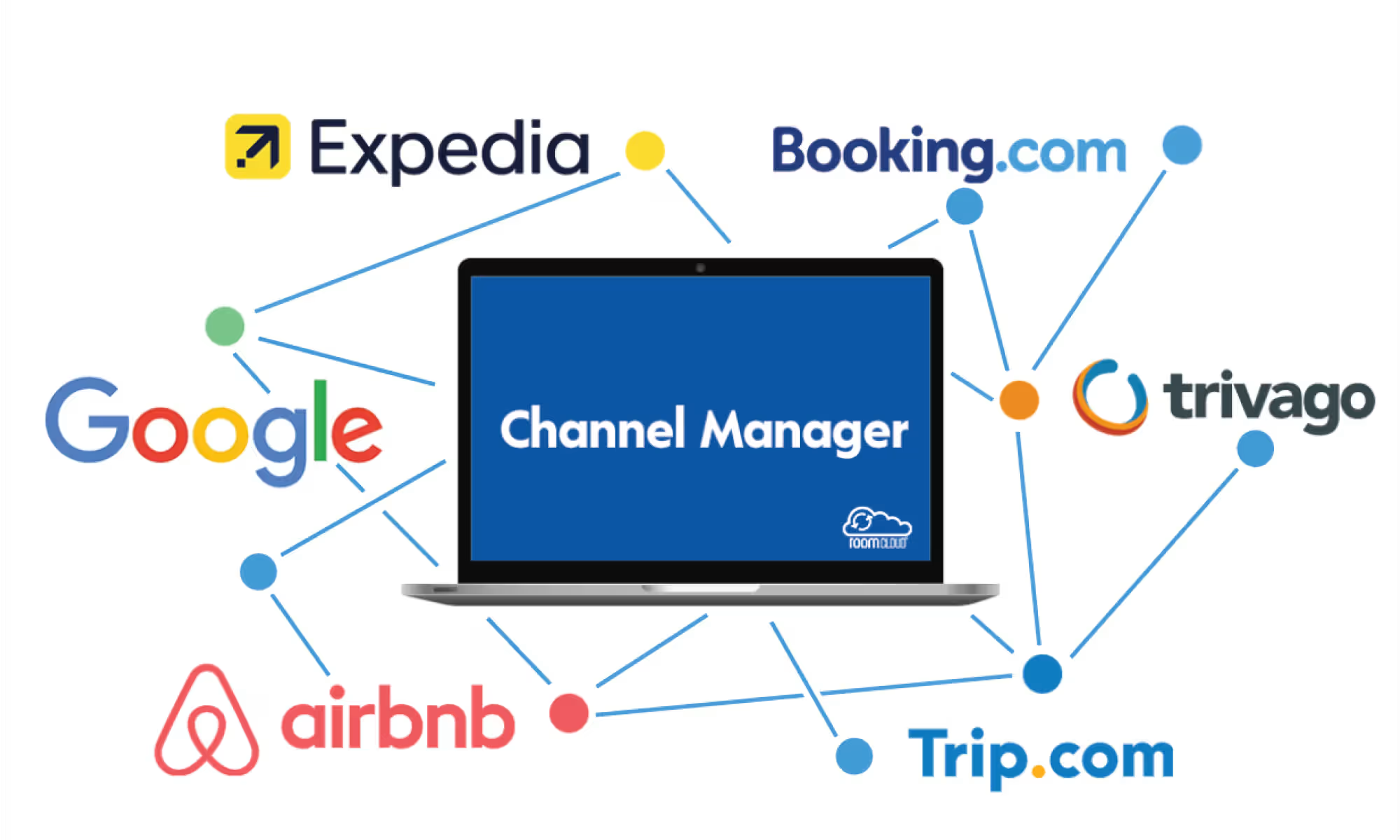
"Channel Manager" laptop connected to Expedia, Booking, Airbnb, Google, trivago and Trip.com
Sébastien Vernay
Founder
The Biloki team shares its expertise to help property management companies optimize their operations.
Published on
20 January 2026
8 min

1 – What a channel manager really is (and what it isn't)

Many people confuse a channel manager with a simple shared calendar. Others think iCal sync is enough. Both mistakes are costly when you scale up.

1.1: The true role of a channel manager

A channel manager is software that connects your listings across all booking platforms (Airbnb, Booking, Abritel, Expedia, and potentially more than 120 OTAs) and synchronizes three critical data points in real time: availability, rates, and stay conditions. When a booking comes in on Booking, the channel manager instantly closes the corresponding dates on Airbnb, Abritel, and all other connected platforms. Not in ten minutes. Not after a manual refresh. In real time. This synchronization speed is what makes the difference between a reliable tool and a double-booking generator. A good channel manager acts like a traffic controller: each booking arrives in the right place, time slots close everywhere else, and you don't have to touch anything manually. The immediate benefit is the pure and simple elimination of the double-booking risk. The secondary benefit is that you can distribute across more platforms without multiplying the risk.

1.2: Why iCal sync is no longer enough

A double booking doesn't just cost you one cancellation. It triggers a cascade of consequences that many managers underestimate. First impact: the platform penalty. Airbnb and Booking penalize host-side cancellations. Your listing loses visibility, your ranking drops, and you receive fewer bookings in the weeks that follow. On Booking, a host cancellation can trigger a negative re-ranking that lasts several months. Second impact: lost time. You have to contact the cancelled guest, apologize, sometimes offer an alternative or a goodwill gesture. For a portfolio of 15 properties, one double booking per month easily means 2 to 3 hours of crisis management per occurrence. Third impact: reputation. A guest cancelled at the last minute leaves a negative review or never comes back. On OTAs, every point lost in your rating translates into missed bookings. Fourth impact: lost revenue. The cancelled slot often stays empty — too late to be re-filled. Multiply that by several double bookings per season, and you're talking about several thousand euros in evaporated revenue. A reliable channel manager is an investment that pays for itself with the very first double booking avoided.

1.3: Channel manager, PMS, concierge software: the differences

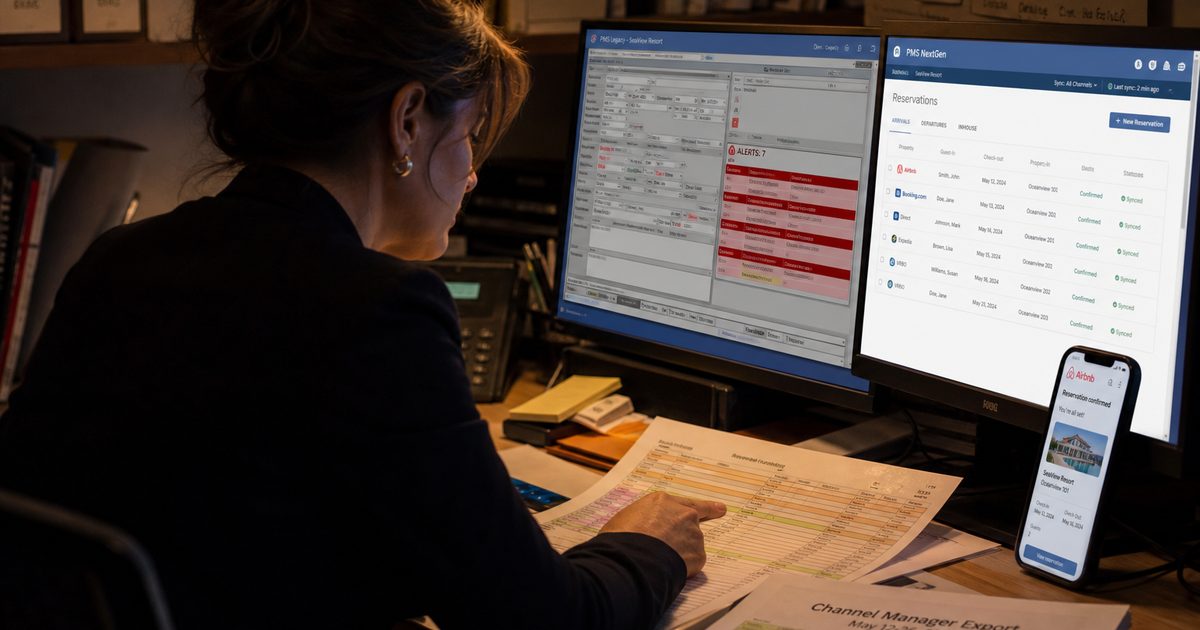
The channel manager handles distribution: it synchronizes your listings and calendars across platforms. The PMS (Property Management System) handles operations: bookings, housekeeping schedules, guest profiles, communication, and invoicing. Some software separates the two. You end up with a channel manager on one side, a PMS on the other, and integrations to maintain between them. Other solutions, like Biloki, unify the channel manager and PMS into a single tool. The benefit is direct: a booking that comes in on Booking is immediately visible in your schedule, triggers the welcome message to the guest, schedules the housekeeping task, and generates the smart lock code. Everything is connected without any additional manual steps. This distinction matters when making your choice. If you evaluate a standalone channel manager, you solve the double-booking problem. If you choose an all-in-one tool, you eliminate double bookings and automate the rest of your operations. For a multi-property manager, the second option saves considerable time. We're concretely talking about up to 20 hours per week for a portfolio of around twenty properties.

2 – How a channel manager eliminates double bookings

A double booking isn't a rare bug. It's a systemic symptom of poorly synchronized multi-platform distribution. Here's how a channel manager cuts the problem at the root.

2.1: Real-time two-way synchronization

A high-performing channel manager operates via direct API connection with each OTA. No exported files, no refresh delays. When a guest books on Airbnb, the API sends the information to the channel manager within seconds. The channel manager immediately updates availability on Booking, Abritel, Expedia, and all other connected platforms. This synchronization is bidirectional: it works in both directions, regardless of the source platform. If a booking is cancelled, the dates automatically reopen everywhere. If you manually block a period in your PMS (maintenance, personal use), the block propagates instantly. The key word here is "real time". A channel manager that updates in near-instant time (under 30 seconds) reduces the risk of double bookings to virtually zero. The larger your portfolio, the more critical this speed becomes. With Biloki, direct connection to more than 120 platforms guarantees this synchronization without going through intermediate connectors that add latency and points of failure. It's this technical layer that allows a manager to distribute broadly without fear.

2.2: The real cost of a double booking

A double booking doesn't just cost you one cancellation. It triggers a cascade of consequences that many managers underestimate. First impact: the platform penalty. Airbnb and Booking penalize host-side cancellations. Your listing loses visibility, your ranking drops, and you receive fewer bookings in the weeks that follow. On Booking, a host cancellation can trigger a negative re-ranking that lasts several months. Second impact: lost time. You have to contact the cancelled guest, apologize, sometimes offer an alternative or a goodwill gesture. For a portfolio of 15 properties, one double booking per month easily means 2 to 3 hours of crisis management per occurrence. Third impact: reputation. A guest cancelled at the last minute leaves a negative review or never comes back. On OTAs, every point lost in your rating translates into missed bookings. Fourth impact: lost revenue. The cancelled slot often stays empty — too late to be re-filled. Multiply that by several double bookings per season, and you're talking about several thousand euros in evaporated revenue. A reliable channel manager is an investment that pays for itself with the very first double booking avoided.

2.3: Real-world scenario — a manager in Bordeaux with 18 properties

Let’s look at a real-world example. A property manager in Bordeaux manages 18 apartments listed on Airbnb, Booking.com, and Abritel. Before switching to a channel manager, they relied on iCal synchronization across the three platforms. During peak season (June to September), they averaged two double bookings per month. Each double booking took between two and four hours to resolve: calling the guest, finding an alternative, dealing with the platform, and sometimes paying for a night in another property out of pocket.

The season-end tally: eight double bookings, approximately 25 hours spent on crisis management, four Airbnb penalties, two negative reviews, and an estimated loss of 4,500 euros (due to unfilled slots and compensation costs).

After activating a channel manager with real-time API synchronization, double bookings dropped to zero. Not "almost zero." Zero. The manager was also able to add two additional platforms (a regional OTA and a direct booking site) without any risk, which increased their occupancy rate by 8 percentage points during the off-season. The combination of a channel manager and an AI assistant capable of handling guest communication has transformed their day-to-day operations.

3 – Choosing and configuring your channel manager without making mistakes

Not all channel managers are equal. The number of connected platforms isn't everything. What matters is synchronization reliability, integration depth, and what the tool does beyond distribution.

3.1: The selection criteria that truly matter

First criterion: native API connection with the platforms you use. Verify that the channel manager is an official partner (Preferred Partner or equivalent) of Airbnb, Booking, and the OTAs where you list your properties. An official connection ensures faster synchronization and support in the event of technical issues.

Second criterion: synchronization speed. Ask for the average propagation time. Under 30 seconds, you are safe. Beyond 2 minutes, the risk of double bookings increases during peak season.

Third criterion: unified management of rates and restrictions. A good channel manager allows you to change a rate once and propagate it everywhere, with the ability to apply adjustments per platform (e.g., different commissions for Booking versus Airbnb).

Fourth criterion: PMS integration. If your channel manager isn't connected to your operational management tool, you will still waste time manually entering information. This is where an all-in-one tool makes the difference. Biloki, for example, integrates a channel manager, PMS, automated messaging and smart locks into a single interface. Every synchronized booking triggers the entire operational chain.

3.2: Configuration mistakes that create false double bookings

Even with a good channel manager, certain setup errors cause problems. The most common: incorrect property mapping. If your "Bordeaux Centre" studio is linked to the wrong Booking listing, the sync blocks the wrong dates on the wrong property. You think you're protected, but the actual property remains open for booking.

Another classic mistake: leaving iCal syncs active in parallel with the channel manager. The two systems conflict with each other, contradict one another, and create ghost blocks or unwanted openings. Simple rule: when you activate a channel manager via API, immediately delete all previous iCal syncs.

Third pitfall: not checking time zones and cut-off times. A mismatch between the platform and the channel manager can open a window of a few hours during which a "closed" date appears as available.

Final point: test your configuration. Before going live across all your properties, run a test on one property for a week. Create a test booking, verify propagation, cancel it, verify the reopening. That's 30 minutes of testing that can save you weeks of headaches.

3.3: Beyond double bookings — what a well-integrated channel manager changes day to day

Eliminating double bookings is the immediate benefit. But a channel manager well-integrated into a PMS transforms your entire daily management.

Distributing across more platforms becomes possible without increasing your workload. More platforms mean more visibility, a higher occupancy rate, and reduced dependence on a single channel. If Airbnb changes its algorithm tomorrow, you aren't left high and dry.

Centralized rate management allows you to react quickly. You adjust your prices from a single dashboard, and the updates are immediate. Coupled with revenue management (dynamic pricing), it is a direct lever for your profitability.

Cascading automation reduces manual tasks. Booking synchronized, confirmation message sent, door code generated, cleaning task scheduled, owner report updated. All of that without you lifting a finger. For a portfolio of 20 properties, that’s effectively up to 20 hours saved per week. Combined with an AI assistant that handles guest questions 24/7, you shift from reactive, stressful management to streamlined, stress-free operations. And your nights become nights again, even in the middle of peak season.

The real cost is continuing without one

Every week without a reliable channel manager means potential double bookings, hours wasted on crisis management, platform penalties, and empty slots. The math is simple: a single double booking during peak season costs more than a year's subscription to a tool that eliminates them all.

If you manage multiple properties across several platforms using iCal syncs or manual checks, you already know it’s not sustainable at scale.

Biloki centralizes your channel manager, PMS, automated messaging,, smart locks, and AI assistant into one single tool. Real-time synchronization across over 120 platforms. Zero double bookings. 14-day free trial. Test it on your portfolio and see the difference from the very first week.

Tags:
#Channel_Manager_for_Property_Management
#Preventing_double_bookings_on_Airbnb_Booking
#OTA_calendar_synchronization
#multichannel_pricing_management
#Channel_Manager_Guide_France
#vacation_rental_management_software

Zero double bookings starting this week

Biloki synchronizes your listings in real time across 120+ platforms. Channel manager, PMS, and automation in a single tool. Free 14-day trial.
Book a demo
Commencer gratuitement