1. Automated check-in, from booking to door opening
Check-in remains the number one friction point in short-term rentals. Not because it's complicated, but because it chains together five or six micro-tasks that depend on each other. And when just one goes wrong, the entire arrival falls apart.
1.1: What really gets stuck in manual check-in
A standard check-in without automation looks like this: you receive the booking, you note the guest's details somewhere, you send them a message with the address and instructions, you generate or retrieve an access code, you verify on the day that everything is in place, you wait for confirmation that they've arrived. Six steps minimum, spread over several days, going through at least three different tools. WhatsApp for communication, a spreadsheet for tracking, a lock app for the code. At 5 properties, it holds together. At 15 or 30, it breaks down. Mistakes multiply. A code not sent, a message sent too late, a wrong address copied from an old template. And every error generates a call, a stressed message, a lower rating. Manual check-in doesn't scale. It survives as long as the volume stays low.
1.2: One property manager, one Friday, three simultaneous arrivals
A property not ready on time means a guest who waits, a potential negative review, and a degraded experience from the very first minute. But there's a less visible cost: the bookings you turn down because you're not sure the cleaning can be done in time. That 11am check-out followed by a 3pm check-in — you block it "to be safe" because you don't know if your contractor will be available. Result: empty nights on time slots that could have been sold. Over a high season, just one property with two or three nights needlessly blocked per month means several hundred euros lost. Multiply that by the number of properties. This isn't a management problem — it's a lack of real-time visibility into your on-the-ground team's availability.
1.3: The automated check-in workflow, step by step
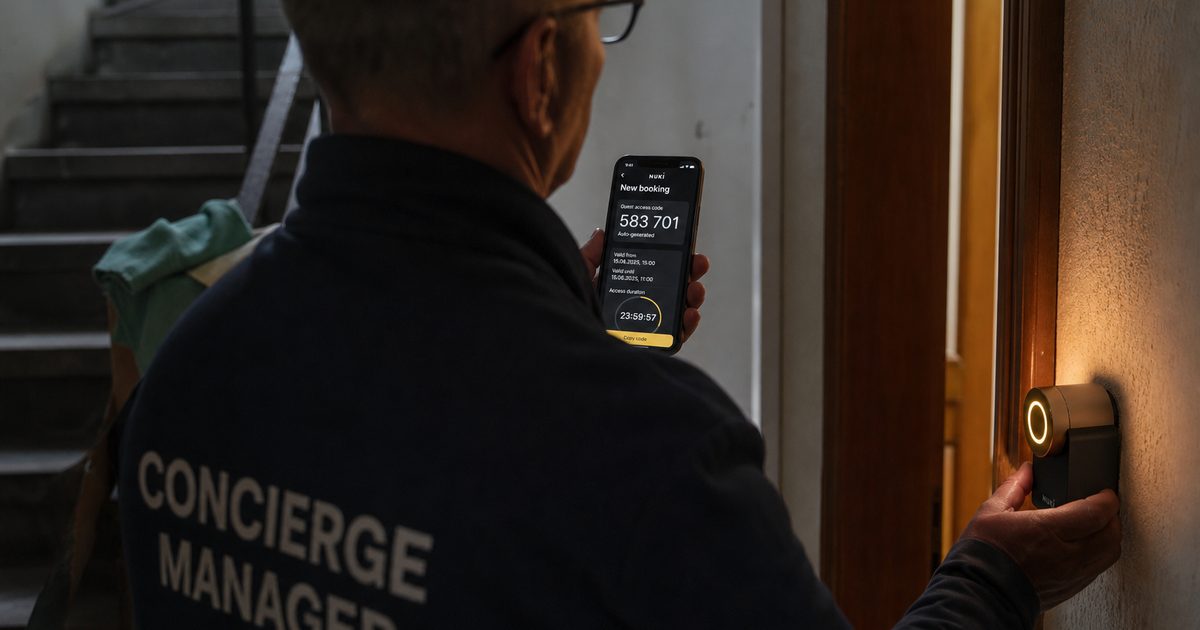
With a PMS like Biloki paired with smart locks, the check-in workflow becomes a sequence that triggers itself. The booking comes in. The system automatically generates a unique access code, valid only for the duration of the stay. A message goes out to the guest with the address, instructions, code and an arrival guide. The day before, a reminder is sent. On the day, the guest enters without any human interaction. The code deactivates automatically after check-out. You haven't touched a thing. No copy-pasting. No forgotten messages. No code lingering from one stay to the next. For concierge services that have already made the switch, this represents an average of 15 to 20 minutes saved per booking. Over 50 bookings per month, the maths speaks for itself. And beyond time, it's reliability that changes. Zero oversights, zero wrong codes, zero guests locked out at 11pm.
2. The cleaning schedule that builds itself
Cleaning between stays is the operational nerve centre. Not because it's hard to do, but because coordinating departures, arrivals and contractors becomes a headache the moment you exceed ten properties.
2.1: Why manual cleaning schedules always go wrong
The problem with a manual cleaning schedule is that it relies on a fragile information chain. You check your booking calendar, you identify the day's check-outs, you call or message your cleaner, you confirm the time slot, you check that she has the right access. Every booking change — late cancellation, extension, last-minute new booking — forces you to restart the entire chain. And when you're managing multiple contractors across several geographic areas, assignment errors multiply. A property overlooked, a contractor sent to the wrong address, a cleaning scheduled but never confirmed. This isn't a cleaning problem. It's an information flow problem. And as long as that flow runs through your head and your phone, there will be gaps.
2.2: What it costs in lost bookings
A property not ready on time means a guest who waits, a potential negative review, and a degraded experience from the very first minute. But there's a less visible cost: the bookings you turn down because you're not sure the cleaning can be done in time. That 11am check-out followed by a 3pm check-in — you block it "to be safe" because you don't know if your contractor will be available. Result: empty nights on time slots that could have been sold. Over a high season, just one property with two or three nights needlessly blocked per month means several hundred euros lost. Multiply that by the number of properties. This isn't a management problem — it's a lack of real-time visibility into your on-the-ground team's availability.
2.3: How the automated cleaning workflow works
In Biloki, every check-out automatically triggers a cleaning task assigned to the contractor linked to that property. The contractor receives a notification with the address, the guest's departure time, the property checklist and the temporary access code. Once the cleaning is done, they confirm in the interface. The property manager sees in real time which properties are ready and which are still being cleaned. If a booking is cancelled or modified, the schedule updates automatically. No more calling, confirming, or chasing. The flow goes from booking to cleaning without going through you. It frees up time, reduces errors, and allows you to accept last-minute bookings knowing exactly whether the property will be ready. Concierge services that automate this workflow recover an average of 3 to 5 hours per week on cleaning coordination alone.
3. Guest messaging that runs without you
Responding to guests is what takes the most time day to day. Not because the questions are complicated, but because they're always the same and they come in at any hour.
3.1: The volume of messages that overwhelms concierge services
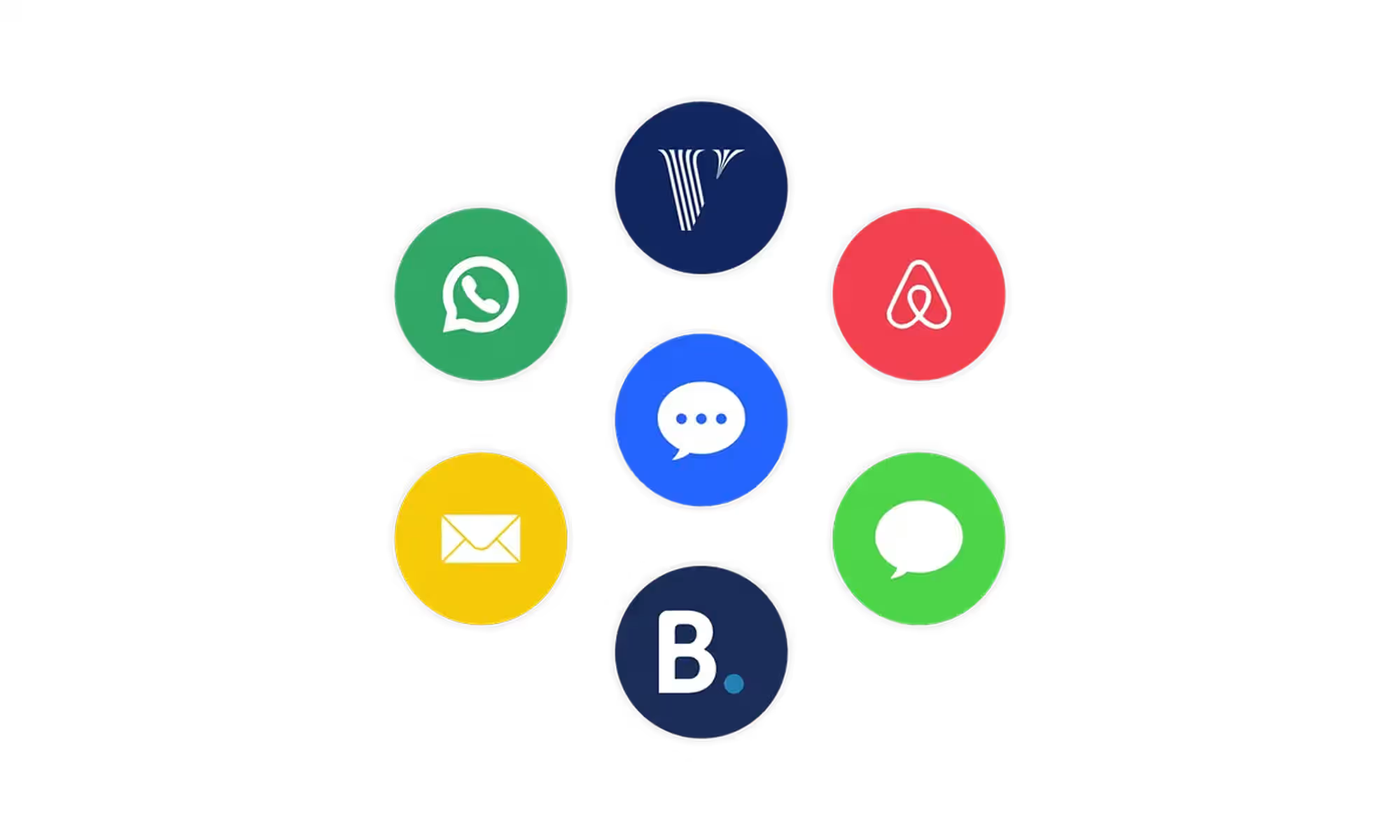
"Where is the key?", "What's the wifi password?", "Can we have a late check-out?", "How does the washing machine work?". These questions account for between 60% and 80% of all guest communications. They're legitimate, but they require no thought on your part. Just time. And that time adds up. A property manager with 20 properties can easily spend 2 to 3 hours a day manually responding to these messages. In peak season, it gets worse. At night, on weekends, during holidays. Guests expect a quick response, and platforms penalise slow response times. You end up a slave to your inbox. If you want to understand how to structure this automation,
the 7 messages that eliminate 70% of your guest communication details the exact templates to put in place.
3.2: The hidden cost of a late reply
On Airbnb, your response rate and average response time directly influence your ranking in search results. A reply that takes more than an hour is a negative signal to the algorithm. But beyond ranking, it's the guest experience that suffers. A guest who asks a question at 11pm and receives a reply the next morning is a frustrated guest. Even if the answer is correct. And that frustration shows up in reviews. Not necessarily as an explicit complaint, but in those details that bring the score down: "average communication", "slow to respond". On the flip side, a guest who receives a clear reply in under two minutes — even an automated one — feels looked after. The perception of quality often depends more on speed than on content.
3.3: The AI assistant that filters and replies on your behalf
Biloki integrates an AI assistant that operates 24/7 and handles routine requests without human intervention. The guest asks their question. The AI identifies the property, the context of the stay, and replies with information specific to that property. Wifi code, waste sorting instructions, how appliances work, check-out times. If the request falls outside the usual scope or requires a decision — extension, technical issue, complaint — the AI escalates to the property manager with full context. You only receive messages that genuinely require your attention. Concierge services that activate this workflow see up to 70% fewer messages to handle manually. To go further on concrete use cases for AI in concierge management,
this article details 4 measurable applications. The result: peaceful nights and guests who feel supported around the clock.
What you lose every week without these 5 workflows
Each of these workflows taken in isolation represents a modest gain. Combined, they transform the daily reality of a concierge service. Automated check-in, cleaning schedule without manual coordination, guest messaging filtered by AI, real-time calendar synchronisation, autonomous owner reporting: that's up to 20 hours recovered per week. It also means double bookings eliminated, improved reviews, and property owners who stay.
Every week without automation, you pay in time, stress and missed opportunities. The number of properties grows, but your days don't get longer.
Biloki centralises these 5 workflows in a single tool. Free 14-day trial. You test it on your properties, with your real workflows. If it changes nothing, you walk away. But at least you'll have measured what you were losing.