1 – The Real Cost of Manual Key Management
Before talking about smart locks, let's look at the numbers. Because the key problem isn't just a logistical inconvenience. It's a line item in time, risk and money that most managers underestimate.
1.1: What You're Really Losing at Every Physical Check-In
Do the math. A physical check-in takes an average of 20 to 40 minutes per stay: travel time, waiting for the guest, explaining how things work, and handing over the keys. For a property management company handling 30 units with a 75% occupancy rate, that’s about 45 check-ins per week. At an average of 30 minutes each, you’re spending 22 hours a week just opening doors.
Then add the unexpected. The guest who arrives two hours early. The one who lands at 11 p.m. when the flight was scheduled for 7 p.m. The owner who changes the lockbox code without telling you. Every hiccup means a phone call, a text, and frantic coordination.
And there’s the hidden cost: while you’re shuttling between apartments, you aren’t prospecting, you aren’t managing your rates, and you aren’t responding to booking inquiries. As shown in our guide on the 5 workflows that save property managers time, key handovers are often the primary operational bottleneck.
1.2: Key Boxes, Code Boxes: Why They're No Longer Enough
igloohome comes from Singapore and was designed from the ground up for short-term rental. Its key feature: PIN codes are generated via an embedded algorithm, with no internet connection required at the moment of opening. In practice, you create a code from the igloohome app (or via the API), and the guest uses it directly on the lock's keypad. No Wi-Fi needed in the property at check-in.
This is a decisive advantage for properties in rural areas, mountain locations, or older buildings where the internet connection is unreliable. The code works within defined time windows: it activates at check-in time and expires automatically at check-out time.
igloohome offers several models: mortise locks (full lock replacement), additional deadbolts, and connected key boxes (for cases where lock replacement is not possible). For property management companies, the most common model is the Smart Keybox 4, which protects a physical key behind a temporary code. It's the compromise between the old world (the key) and the new (the automated code). One point to note: full lock replacement requires checking compatibility with French doors. The mortise format is not always standard.
1.3: A Concrete Case: 15 Properties, 3 Lost Keys Per Month
Take the case of a property management company on the Basque Coast. 15 properties, peak season from May to October. Before switching to smart locks, the manager used a mix of key boxes and in-person handovers. Monthly result in peak season: 3 lost or unreturned keys, 2 emergency locksmith call-outs (at a minimum of 150 euros per evening call-out), and at least 4 delayed check-ins due to flight delays.
The direct cost: around 500 euros per month just for keys. The indirect cost: mediocre reviews linked to arrival ("check-in was complicated", "we waited 20 minutes at the door"). On Airbnb, the arrival rating directly impacts listing ranking and therefore visibility.
This manager switched to igloohome for 8 properties and Nuki for the other 7 (depending on door type and building constraints). Within three months: zero lost keys, zero locksmith call-outs, and the average arrival rating went from 4.3 to 4.8. It doesn't sound dramatic on paper. But over a year, it changes the trajectory of a business.
2 – Nuki vs igloohome: What Really Matters for a Property Management Company
These two brands dominate the smart lock market for short-term rentals in Europe. But they don't work the same way, and the right choice depends on your portfolio, your doors, and your management style.
2.1: Nuki, the Choice for Flexibility on European Cylinders
Nuki is an Austrian brand. Its flagship product, the Nuki Smart Lock (currently version 4.0), fits on the inside of the door, over the existing cylinder. No need to change the lock, no drilling required: it's a motorized unit that turns the key for you.
For a property management company, the main advantage is compatibility. The vast majority of doors in France use a standard European cylinder. Nuki fits without modification, avoiding friction with owners and building management companies. Installation takes 10 to 15 minutes.
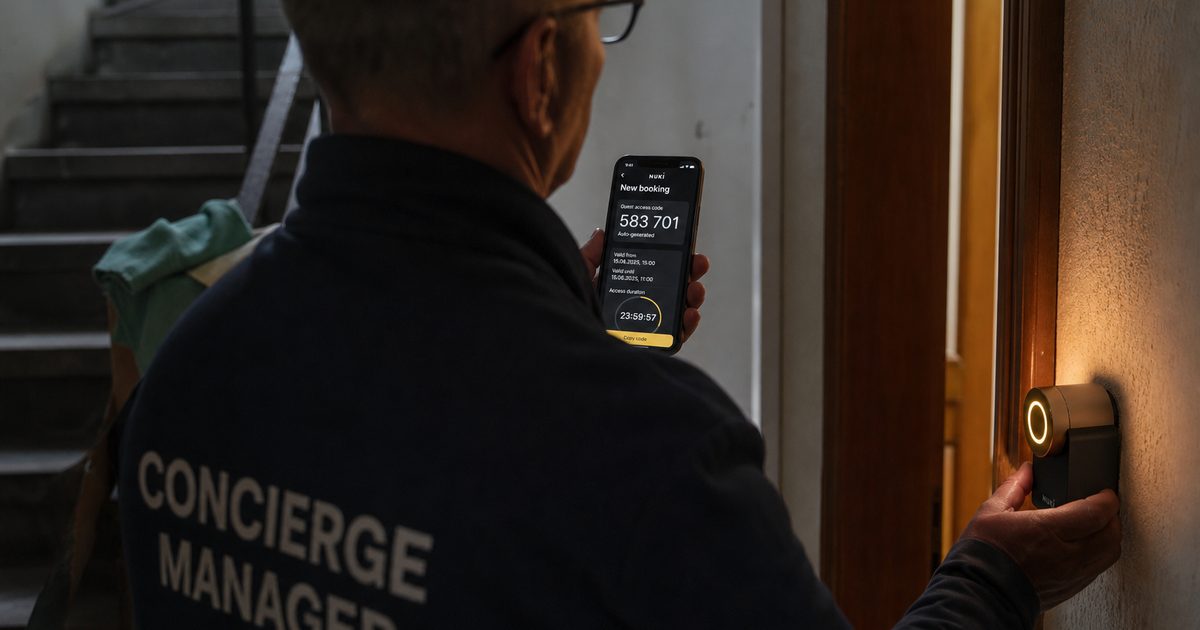
In terms of functionality: Nuki allows you to generate temporary codes via its keypad (Nuki Keypad, sold separately) or unlock remotely via Bluetooth or Wi-Fi (with the Nuki bridge). Every opening is time-stamped in the app. You know exactly when the guest entered, when the cleaning team came through, and if anyone tried to access the property outside of scheduled windows. The weak point: Nuki runs on batteries, and the stated battery life (4 to 6 months) can drop to 2 months with heavy use. Battery level monitoring needs to be built into your routine.
2.2: igloohome, Designed for Remote Management Without Wi-Fi
igloohome comes from Singapore and was designed from the ground up for short-term rental. Its key feature: PIN codes are generated via an embedded algorithm, with no internet connection required at the moment of opening. In practice, you create a code from the igloohome app (or via the API), and the guest uses it directly on the lock's keypad. No Wi-Fi needed in the property at check-in.
This is a decisive advantage for properties in rural areas, mountain locations, or older buildings where the internet connection is unreliable. The code works within defined time windows: it activates at check-in time and expires automatically at check-out time.
igloohome offers several models: mortise locks (full lock replacement), additional deadbolts, and connected key boxes (for cases where lock replacement is not possible). For property management companies, the most common model is the Smart Keybox 4, which protects a physical key behind a temporary code. It's the compromise between the old world (the key) and the new (the automated code). One point to note: full lock replacement requires checking compatibility with French doors. The mortise format is not always standard.
2.3: Concrete Selection Criteria Based on Your Portfolio
The question isn't "which is the best lock" but "which lock for which property". Here are the criteria that matter in the field.
Door type: if the door has a standard European cylinder and the owner refuses to modify the lock, Nuki is the logical choice. If you can replace the lock or need a connected key box, igloohome offers more options.
Connectivity: if the property has reliable Wi-Fi, both work. If the connection is unstable or absent, igloohome has the advantage thanks to its offline code system.
Portfolio volume: beyond 20 properties, the central question becomes integration with your PMS. Manually generating a code per stay in the manufacturer's app is manageable for 5 properties. For 50, it's unworkable. That's where automation via centralized software changes the game, as we detail in the next section.
Budget: expect around 150 to 250 euros per Nuki lock (excluding keypad and bridge), and 100 to 300 euros for igloohome depending on the model. Return on investment is typically achieved within 2 to 4 months thanks to the elimination of manual interventions and locksmith fees.
3 – Automating Access Codes End-to-End via a PMS
Installing smart locks is the first step. But the real gain comes when codes are generated and deactivated automatically, without human intervention, directly from your management tool.
3.1: Why PMS Integration Changes Everything
Without an integration, here is what happens: a booking comes in on Airbnb. You see it in your PMS or channel manager. You open the Nuki or igloohome app. You create a code with the correct dates and times. You send the code to the guest via message. You do this for every booking, for every property, every single day.
With a PMS integration, the process is as follows: the booking comes in. The system automatically generates a unique code linked to the stay dates. The code is sent to the guest in the pre-arrival message. At the end of the stay, the code expires. You didn't have to do a thing.
This is exactly what Biloki enables with its Nuki and igloohome integrations. Every booking synchronized from the 120+ platforms connected via the channel manager triggers the automatic creation and sending of the access code. The manager sees everything from a single dashboard, and the guest receives their instructions without delay. To understand how a well-chosen PMS centralizes this entire chain, it is the foundation you need to master before connecting anything else.
3.2: Self Check-In from A to Z, as It Works in Practice
Here is the complete guest journey when everything is automated. Two days before arrival, the guest receives a message (via email or platform) containing their access code, instructions for finding the property, and building rules. This message is sent automatically by the PMS automated messaging system.
On the day of arrival, the guest arrives and enters their code on the keypad. The door opens. No waiting, no key boxes to hunt for, and no need to call the property manager. If they have a question about how the heating works or the Wi-Fi password, the AI guest assistant integrated into Biloki provides real-time answers, 24/7.
On the day of departure, the code automatically expires at the scheduled time. The cleaning team has their own code, which is only active during their designated slot. The next guest will receive a new, unique code for their specific dates. No code remains active after use. No human intervention was required at any point in the process.
This type of automation also speeds up the onboarding of new properties : once the lock is installed and connected to the PMS, the property is immediately ready for guests.
3.3: Security, Traceability and Peace of Mind for Property Owners
One of the most effective arguments when prospecting a new owner is: "Every entry to your property is tracked, time-stamped, and visible in your dashboard." Owners using full-service management want to know who is entering their property and when. With a smart lock integrated into the PMS, every event is recorded: guest check-in, cleaning crew arrival, and code expiration.
If a guest reports an issue or damage, you have a precise access log. No more "he said, she said." The facts are time-stamped.
In terms of security, temporary codes eliminate the risk of key duplication. A guest copying a physical key happens more often than you might think. With a code that expires, that issue disappears. And for owners worried about reliability: Nuki and igloohome also work with a physical backup key. The smart lock doesn't replace the mechanism; it adds to it.
For managers who want to take intelligent stay tracking even further, the integrated AI can detect anomalies such as a check-in that didn't happen at the scheduled time, and trigger an automatic alert.
Every Manual Check-In Is a Risk You Can Eliminate Today
You can keep running between apartments with a bunch of keys. You can keep sending codes manually across three different apps. You can keep hoping that the 11 PM guest finds the key box without calling you.
Or you can install a smart lock, connect it to a PMS that handles everything, and never think about it again.
Property management companies that switch to access code automation reclaim an average of 20 hours per week. They eliminate locksmith call-outs. They improve their arrival ratings. And they can take on new properties without hiring.
Biloki natively integrates Nuki and igloohome. Codes are created and expire with every booking, with no action required on your part. Try it free for 30 days, no credit card required, and see what changes from the very first week.