1. What Really Blocks a PMS Migration in Vacation Rentals
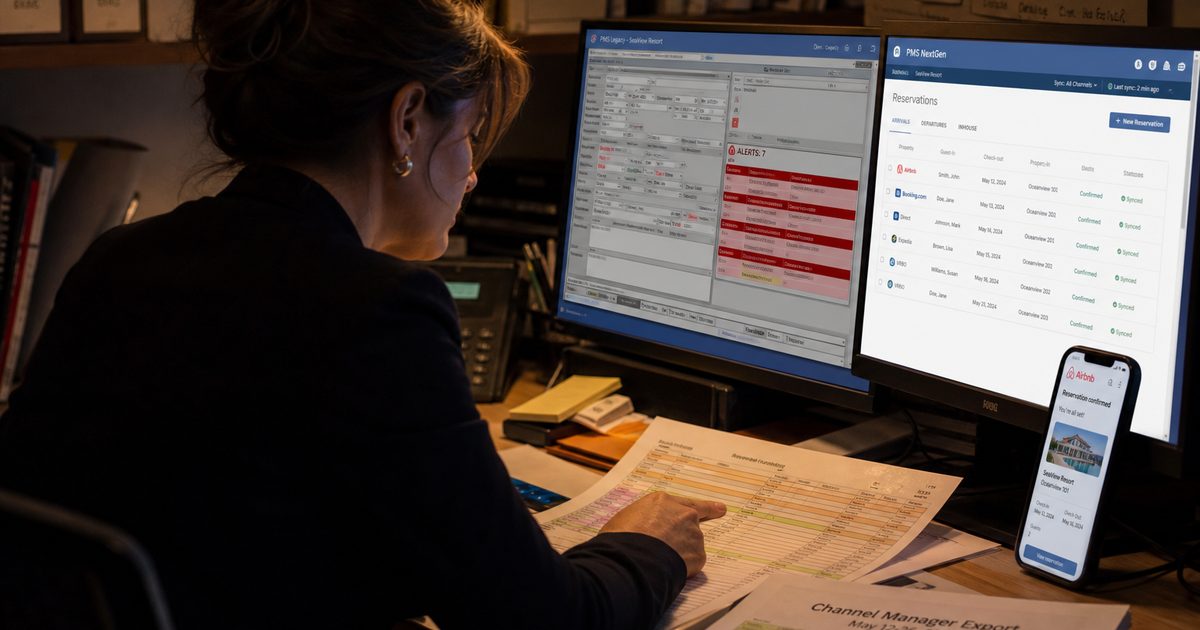
Switching PMS isn't like switching a phone plan. Your rental management software is connected to your platforms, your locks, your accounting, your teams. Everything is intertwined. And it's precisely this interconnection that turns a simple decision into a project that drags on for months.
1.1: The Real Reason You Keep Putting Off the Switch
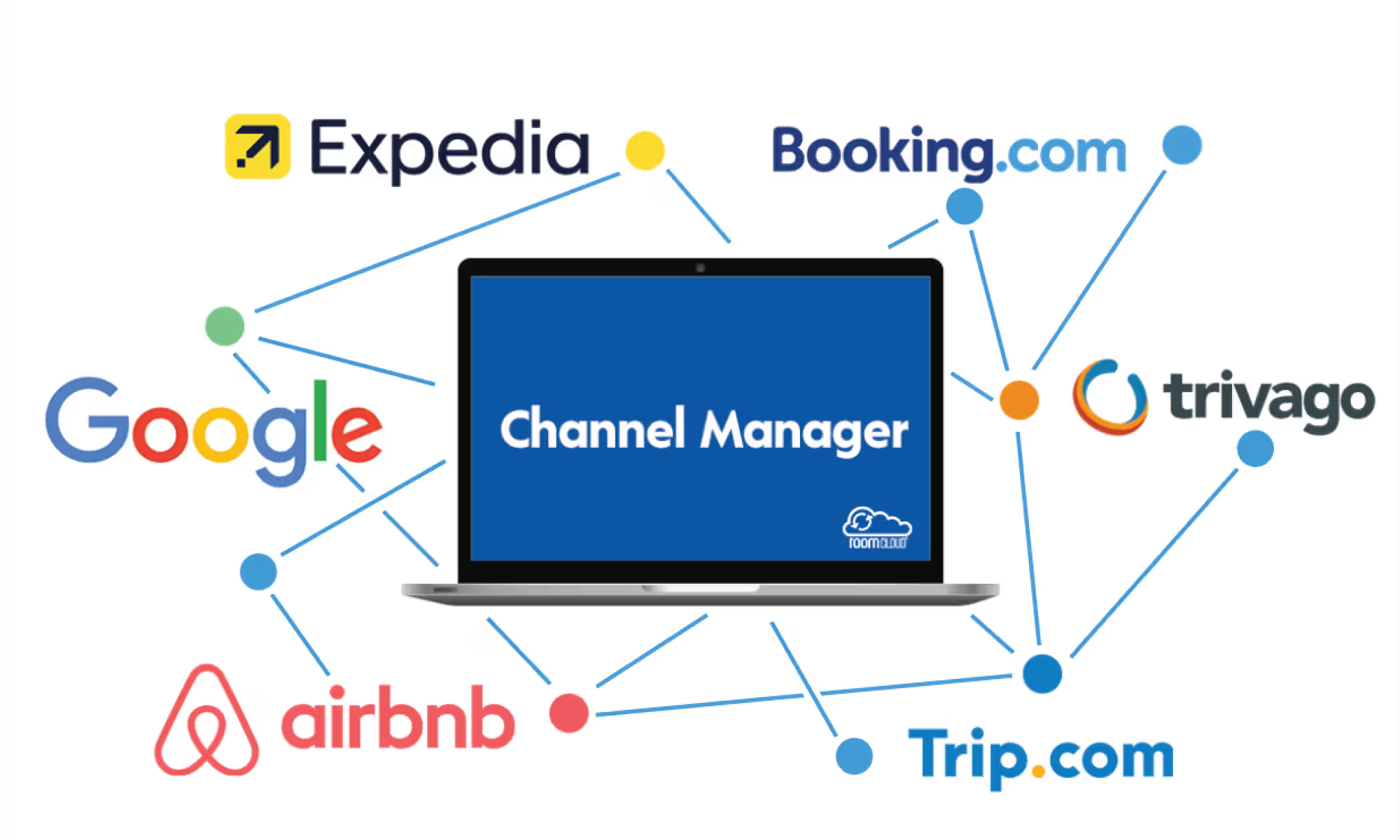
It's not a lack of time. It's a lack of visibility into what will happen during the switchover. You manage 20, 50, 100 properties. Each one is connected to two or three OTAs. Every unit has its cleaning schedule, seasonal rates, and minimum stay rules. And all of that lives in your current PMS.
The question that paralyzes you: "If I unplug, what falls apart?"
Nobody gives you a clear answer. Your current PMS has no interest in making your departure easy. The new vendor promises everything will be "seamless," but you've heard that before.
Result: you stay. You compensate for your tool's shortcomings with spreadsheets, WhatsApp groups, and overtime. And every month that passes makes the migration a little heavier, because data keeps accumulating in a system you'll end up leaving anyway.
1.2: What You're Concretely Risking If the Migration Is Poorly Prepared
This is the most delicate moment. For a few days, your two systems will coexist. The goal: have the new PMS ready to take over before shutting down the old one.
Step 1: configure all your properties in the new PMS. Import the exported data. Check every listing. This is the moment to fix what had been left unattended: outdated descriptions, inconsistent rates, missing photos. If your new PMS allows
onboarding rapide des logements, this step can move quickly.
Step 2: switch OTA connections one by one. Not all at once. Start with one test property. Verify that the calendar syncs correctly. That rates are pushed through. That existing bookings appear. Once validated, move on to the next ones in batches of 5 to 10 properties.
Step 3: during the switchover of each connection, manually block calendars on the old PMS to avoid conflicts. This is the only window of vulnerability. It typically lasts between 15 and 45 minutes per property.
1.3: The Typical Case of the Manager Who Waited Too Long
A property manager in the South of France with 35 units. Their original PMS worked fine at 10 properties. At 35, the limitations became a daily reality: no proper owner interface, an unstable channel manager, no smart lock management.
They postponed the migration for 14 months. During that time, they hired a part-time employee solely to compensate for the gaps in their tool. Annual cost of that workaround: approximately 12,000 euros.
When they finally migrated, they did it in the middle of peak season. Because they couldn't take it anymore. Result: three double bookings in the first week, two owners threatening to leave, and a month of intense stress.
The lesson is simple. Delaying the migration doesn't reduce the risk. It increases it. Every month spent on an inadequate tool widens the gap between what you need and what you're using. The question isn't "should I migrate" — it's "how do I migrate cleanly."
2. The Method for Migrating Without Interruption or Data Loss
A successful migration isn't a matter of luck. It's a precise sequence of actions, in the right order, with the right tools. Here is the process that works, tested by property management companies managing dozens of units.
2.1: Prepare the Export Before Touching Anything
Before creating a single account on your new PMS, you need to know exactly what you're taking with you. Do a complete inventory of your critical data.
Current and future bookings: dates, amounts, guest contact details, payment statuses. Historical booking records: essential for your owner reports and accounting. Property listings: descriptions, photos, rates, stay rules, amenities. Automated message templates. Access credentials for your OTA connections.
Export everything your current PMS allows you to export. CSV, Excel, API — whatever the format. Store these files in a dedicated, dated folder. That's your safety net.
Critical point: check the exit conditions of your current PMS. Some vendors restrict exports or delete your data upon cancellation. Read the terms and conditions before clicking "cancel my subscription." If you chose your software by following
les bons critères de sélection d'un PMS, data portability is part of the checklist.
2.2: The Dual-Operation Phase — How to Manage It Without Chaos
This is the most delicate moment. For a few days, your two systems will coexist. The goal: have the new PMS ready to take over before shutting down the old one.
Step 1: configure all your properties in the new PMS. Import the exported data. Check every listing. This is the moment to fix what had been left unattended: outdated descriptions, inconsistent rates, missing photos. If your new PMS allows
onboarding rapide des logements, this step can move quickly.
Step 2: switch OTA connections one by one. Not all at once. Start with one test property. Verify that the calendar syncs correctly. That rates are pushed through. That existing bookings appear. Once validated, move on to the next ones in batches of 5 to 10 properties.
Step 3: during the switchover of each connection, manually block calendars on the old PMS to avoid conflicts. This is the only window of vulnerability. It typically lasts between 15 and 45 minutes per property.
2.3: What to Test Before Shutting Down the Old System
Don't cut anything until you've verified these five points on the new PMS.
First point: calendars. Each property must show the correct availability on every OTA. Perform a manual cross-check on Airbnb and Booking for at least 10 properties.
Second point: future bookings. All already confirmed reservations must appear with the correct dates, amounts, and guest contact details.
Third point: automated messages. Run a test to verify that your pre-arrival, check-in instruction, and post-stay messages are being sent correctly. The automated messages that really matter must work from day one.
Fourth point: smart locks. If you use locks like Nuki or igloohome, verify that codes are being generated automatically for upcoming check-ins.
Fifth point: owner access. Your owners must be able to view their earnings and calendars without interruption.
Once these five points are verified, you can deactivate your old PMS. Not before.
3. After the Migration: Securing the First Weeks and Making the Most of It
The technical switchover is done. But the migration isn't over. The first two weeks on your new PMS determine whether your team adopts the tool or falls back into old habits.
3.1: The First 48 Hours — Your Active Monitoring Period
For the first two days, keep a close watch on everything. Check every new booking as it comes in. Confirm that synchronization is working both ways: a booking on Airbnb should correctly block the calendar on Booking.com, and vice versa.
Keep an eye on your automated messages. The first guest to receive a blank message or a missing access code will reach out to you, and rightly so. It is better to spot the issue before they do.
Pro tip: create a test booking for a dummy listing or a property that is temporarily blocked. Go through the entire cycle, from the booking itself to the check-out message. It takes 15 minutes and can save you hours of fixing things later.
If your new PMS includes an AI assistant for guest messaging, verify that its responses are consistent with your properties and house rules. The AI needs the right information to function correctly from the start.
3.2: Training the Team Without Losing a Week
A PMS your team doesn't use correctly is worse than no PMS at all. But "training the team" doesn't mean organizing a full-day training session with PowerPoint slides.
Identify the three actions each role performs most often. For a field concierge: checking the cleaning schedule, accessing property instructions, reporting an issue. For a manager: reviewing the day's bookings, adjusting a rate, responding to an owner.
Show those three actions in 15 minutes. No more. The rest is learned by using the tool.
If your new PMS offers interfaces tailored to each role, training becomes much simpler. A concierge doesn't need to see revenue figures. An owner doesn't need to see guest messages. Everyone sees what concerns them, nothing more.
In the first few days, designate a point person on the team. Someone who knows the tool well and can answer colleagues' questions without everything escalating to you.
3.3: Using the Migration to Fix What Had Been Left Unattended
Switching PMS is also an opportunity to start fresh with a clean slate. All those rates you never recalibrated, those property listings with descriptions from 2022, those minimum stay rules that no longer match your strategy — now is the time.
Revisit your pricing grids. A migration is the ideal moment to implement a real dynamic pricing logic. If you had inconsistencies between platforms, they must not survive the transfer.
Clean up your guest profiles. Remove duplicates. Verify that contact details are up to date.
Activate the features your old PMS didn't offer. That's probably why you migrated. Smart locks, automated messaging, owner portal — don't let these tools sit idle for weeks.
Donnez à vos propriétaires un accès en temps réel dès le premier jour. That's the best proof that the switch was the right call.
A well-executed migration isn't about returning to the same starting point with a new tool. It's about reaching a level of operation your old system couldn't allow you to achieve.
Every Day on the Wrong Tool Is One Day Too Many
Your current PMS costs you time every week. Hours spent compensating for its limitations. Errors that wouldn't exist with the right tool. Owners asking questions you can't answer in a single click.
Migration is scary because it touches everything that keeps your business running. But with the right method, it takes a few days, not a few months. Clean export, progressive switchover, systematic validation, active monitoring.
And once it's in place, you get those hours back. You stop patching things together. You run your business instead of chasing after it.
Biloki supports the migration from start to finish: data import, OTA connection, automation configuration. Try it free for 30 days, no credit card required, and see the difference for yourself.