1 – The three messages before arrival: setting the stage effortlessly
The period between booking and check-in concentrates the majority of guest questions. Three well-timed messages are enough to cut off 80% of them. The goal: anticipate every question before it becomes a message in your inbox.
1.1: The booking confirmation message
The problem is the silence. A guest makes a booking and for two days, nothing. They start to doubt. They send an initial message: "Hi, did my booking go through?" Multiplied by 30 bookings a month, that’s an hour wasted reassuring people who never should have been worried in the first place.
The confirmation message goes out within minutes of the booking. It contains three things: a thank you, the exact address of the property, and a sentence letting them know that all practical information will arrive before their stay. Nothing more.
On Biloki, this message is triggered automatically when a booking is created, regardless of the source platform. You set it up once, and it runs across your entire portfolio. A property manager in Bordeaux with 35 apartments found that this single message eliminated about 15 messages per week. Automation like that described in our article on AI for concierge services: 4 concrete and measurable use cases shows just how quickly these small gains add up when you multiply them across an entire portfolio.
1.2: The pre-stay message with practical information
For stays of five nights or more, radio silence between arrival and departure creates a void. The guest feels left to their own devices. If they have an issue that's getting worse (a broken heater in winter, recurring noise from neighbors), they say nothing and then vent in the review.
This fifth message is optional for short stays but critical for medium and long stays. It goes out at the halfway point. It checks in with a single sentence and offers help. Some property managers add a local recommendation (a restaurant, a market) to personalize the experience.
The cost of not sending it: bad surprises at check-out. A property management company in Annecy reduced negative reviews by 30% simply by adding this mid-stay touchpoint for properties in tourist areas. The trigger in Biloki is straightforward: if the stay exceeds X nights, the message goes out automatically at day X/2. A one-time setup that then runs across the entire portfolio.
1.3: The check-in message with access code
The big day. This is the most critical message in the entire sequence. A guest who doesn't have their arrival instructions at the expected time is a guaranteed phone call, often at the worst moment.
This message goes out on the morning of arrival, or the evening before for early arrivals. It contains the check-in time, the door access code (or key handover instructions), and a reminder of the essential house rules. Short, structured, impossible to miss.
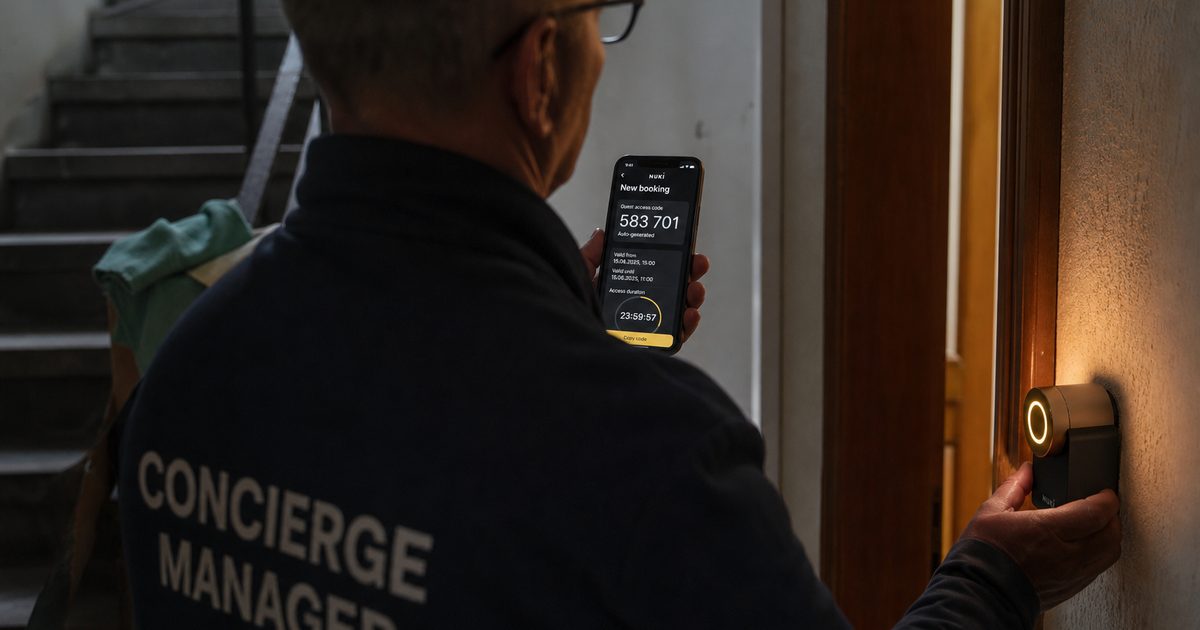
The real power comes when the access code is generated automatically. With smart locks integrated into Biloki, each stay has a unique code, active only for the duration of the booking. The message goes out with the right code, at the right time, without you lifting a finger. No more panicked phone calls at the door at 11 PM. No more former guests returning with a code that's still active. A property manager on the French Riviera who switched to this system eliminated 100% of physical key handovers across 22 properties.
2 – The two messages during the stay: staying present without hovering
Once the guest is settled in, many property managers go silent until check-out. That's a mistake. Satisfaction and the final rating are built during the stay. Two messages are enough to keep the connection without being intrusive.
2.1: The welcome message after check-in
The guest has just arrived. They're discovering the property. This is the exact moment they notice something that bothers them: a burnt-out bulb, a dripping tap, a remote control they can't find. If they don't have a simple channel to report it, they'll save it for the review.
The fourth message goes out one to two hours after the check-in time. It says: "I hope your arrival went smoothly. If anything isn't right, just reply here." That's it. The goal isn't to deliver five-star service — it's to catch irritants before they become negative comments.
This message has a measurable impact on ratings. By opening a proactive reporting channel, you pick up issues in real time instead of discovering them in a public review. Biloki's guest AI assistant can even handle replies automatically: if the guest asks how to turn on the air conditioning, the AI responds by drawing on the property's information sheet, without waking you up at 2 AM.
2.2: The mid-stay message for longer stays
For stays of five nights or more, radio silence between arrival and departure creates a void. The guest feels left to their own devices. If they have an issue that's getting worse (a broken heater in winter, recurring noise from neighbors), they say nothing and then vent in the review.
This fifth message is optional for short stays but critical for medium and long stays. It goes out at the halfway point. It checks in with a single sentence and offers help. Some property managers add a local recommendation (a restaurant, a market) to personalize the experience.
The cost of not sending it: bad surprises at check-out. A property management company in Annecy reduced negative reviews by 30% simply by adding this mid-stay touchpoint for properties in tourist areas. The trigger in Biloki is straightforward: if the stay exceeds X nights, the message goes out automatically at day X/2. A one-time setup that then runs across the entire portfolio.
2.3: What it costs to automate nothing during the stay
A property manager handling 25 listings with a 75% occupancy rate processes around 560 stays per year. Without automated messages during the stay, each guest generates an average of 3 to 5 exchanges (WiFi, heating, neighborhood questions, issue reports). That's between 1,680 and 2,800 messages per year that you answer manually.
At an average of 3 minutes per message (reading, understanding, drafting, sending), that comes to 84 to 140 hours per year just for mid-stay exchanges. That's three weeks of work. Swallowed up by replies that could have been anticipated or handled by an AI.
With Biloki, the guest AI assistant handles common questions 24/7 by drawing on each property's information. Proactive messages (welcome and mid-stay) cut the flow of questions at the source. The result observed among users: up to 70% fewer guest messages. This is not a theoretical gain. It's real time you reclaim every week to run your business instead of managing your inbox.
3 – The two messages after departure: securing the rating and building loyalty
The stay is over, but the work isn't done. The last two messages in the sequence are the ones that protect your reputation and create a virtuous cycle. Too many property managers neglect them, even though this is where the public rating is decided.
3.1: The check-out message with clear instructions
The sixth message goes out the evening before departure or on the morning itself. It reminds the guest of the check-out time, the departure instructions (bins, keys, thermostat, shutters), and thanks them. Short, precise, unambiguous.
The problem without this message: late departures that delay cleaning and put the next check-in at risk. Bins left anywhere that generate neighbor complaints. Properties returned in a state that extends turnaround time.
A common micro-scenario: a guest leaves at noon instead of 10 AM because they didn't have the information. The cleaning team arrives and can't clean. The next guest is expected at 3 PM. The result: stress, a cascade of calls, degraded cleaning quality, and the next guest arriving to a property that isn't quite ready. All of that for a message that would have taken zero seconds to send if it had been automated. In Biloki, this message is linked to the cleaning schedule: when check-out is confirmed, the cleaning team automatically receives their notification.
3.2: The post-stay review request message
The seventh and final message is the most underestimated. It goes out 24 to 48 hours after departure. Its goal: to obtain a positive review on the booking platform.
Most satisfied guests don't leave reviews spontaneously. Dissatisfied ones do. Without a follow-up, your review profile naturally skews negative. This message corrects that imbalance by reminding the guest that their feedback matters and making it easy for them to leave a review.
The content is simple: a sincere thank-you, a sentence saying that their review helps other guests, and a direct link to the review page. No pressure, no manipulative wording. Just a well-timed reminder. Property management companies that systematize this follow-up see a 25 to 40% increase in reviews received. And more positive reviews means a better ranking on platforms, which means more visibility, which means more bookings. The cycle is virtuous and it starts with a 30-word automated message.
3.3: Orchestrating all 7 messages without thinking about it
Seven messages sounds simple on paper. In practice, when you're managing 30 properties simultaneously on Airbnb, Booking, and Abritel, the complexity explodes. Each platform has its own messaging constraints. Check-in times vary by property. Long stays have different needs than short ones.
This is exactly where a PMS with built-in automated messaging changes everything. You create your 7 templates once. You define the triggers (at booking, 4 days before arrival, day of arrival, 2 hours after check-in, mid-stay, evening before departure, 2 days after check-out). Variables fill in automatically: guest name, address, access code, property-specific instructions.
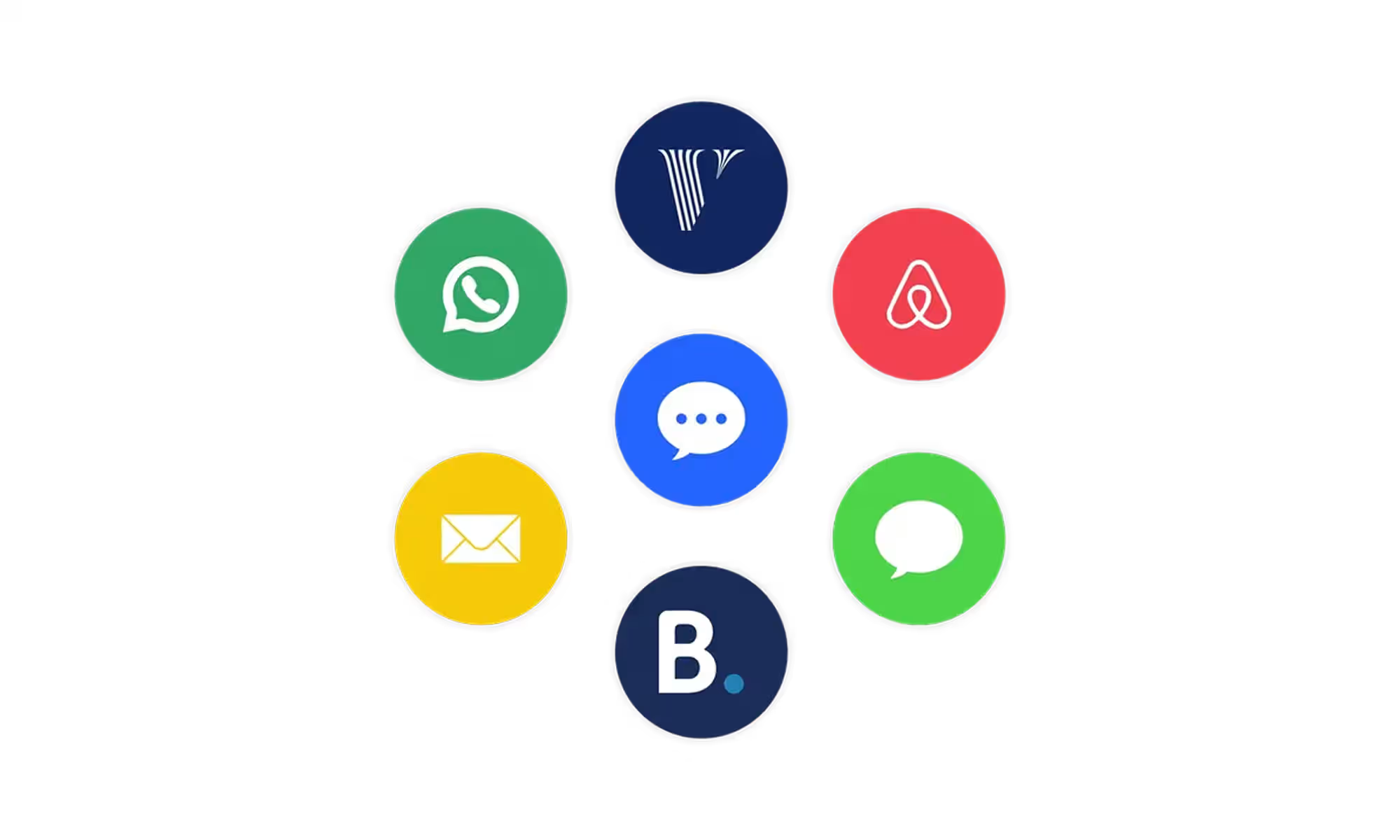
With Biloki, these messages are synchronized with the channel manager (over 120 platforms), smart locks (the access code in the message is always correct), and the AI assistant that takes over when a guest replies with a question. It's a system, not a list of copy-pasted templates. You configure it once, it runs across your entire portfolio, and you reclaim up to 20 hours per week. Not in theory. In real hours you no longer spend buried in your inbox.
Every message not sent is a problem waiting to happen
You know the reality. It's never just one missed message that tips everything over. It's the accumulation: the missed confirmation that generates a call, the access code sent late that ruins an arrival, the review request never sent that leaves your profile stagnating. Seven messages. Seven touchpoints. That's all it takes to transform reactive management into a machine that runs without you.
Every week you continue sending your messages manually is time lost, ratings missed, and bookings that don't come back.
Biloki automates these 7 messages across your entire portfolio, with integrated access codes and a 24/7 guest AI. Free 14-day trial. You configure, you test, you measure.