



1 – What Excel does well, and the wall it hits you with from 5 properties onwards
1.1: The file that grows faster than your ability to maintain it
1.2: What these errors actually cost every month
Beyond time, there are costs you don't measure because Excel doesn't display them. The first: unsold nights. Without dynamic pricing or a consolidated view of your occupancy rate, you underprice in peak season and overprice in low season. The second: response time to guests. A message left unanswered within an hour drops your conversion rate on Airbnb. When messages come through your phone rather than a centralized system with AI, delays mechanically increase at night and on weekends. The third: dependency on a single person. If everything relies on one manager's spreadsheet, any absence (illness, holiday, departure) paralyzes operations. A PMS creates continuity of service that is independent of individuals. On the messaging front, the 7 messages that eliminate 70% of guest communication shows what automation concretely changes on a day-to-day basis.
1.3: The case of the concierge service with 12 properties that "managed fine with Excel"
2 – The tipping point: when a PMS becomes cheaper than Excel
2.1: The calculation nobody does, but every manager should run
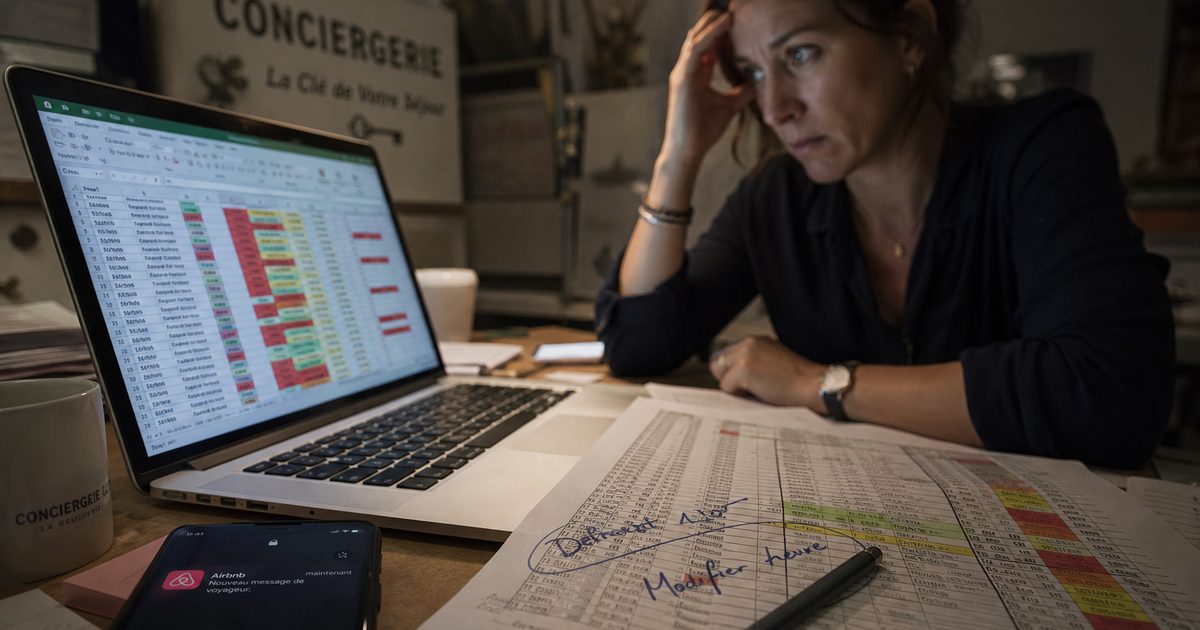
Take a typical week. Count the time spent on these tasks: manually entering bookings into the spreadsheet, updating calendars on each platform, sending arrival instructions, coordinating cleaning via SMS or WhatsApp, preparing owner statements, managing key box codes. Multiply those hours by your real hourly rate (or that of the person doing it). At 10 properties, the managers we encounter report between 12 and 20 hours per week on these tasks. At 25 euros per hour, that's 300 to 500 euros per week in pure management time. A PMS with an integrated channel manager, connected locks and automated messaging absorbs 70 to 80% of that time. If your manual management cost exceeds 400 euros per month, the PMS pays for itself from the first month. To see concretely which workflows disappear with a PMS, this article on the 5 workflows to automate lays out the fundamentals.
2.2: The hidden costs that Excel never shows in its columns
Beyond time, there are costs you don't measure because Excel doesn't display them. The first: unsold nights. Without dynamic pricing or a consolidated view of your occupancy rate, you underprice in peak season and overprice in low season. The second: response time to guests. A message left unanswered within an hour drops your conversion rate on Airbnb. When messages come through your phone rather than a centralized system with AI, delays mechanically increase at night and on weekends. The third: dependency on a single person. If everything relies on one manager's spreadsheet, any absence (illness, holiday, departure) paralyzes operations. A PMS creates continuity of service that is independent of individuals. On the messaging front, the 7 messages that eliminate 70% of guest communication shows what automation concretely changes on a day-to-day basis.
2.3: The 5-property threshold, confirmed in the field
After observing dozens of concierge services in their growth phase, the threshold sits at around 5 active properties across at least 2 platforms. Below that, Excel remains viable if you are rigorous and the sole decision-maker. Above it, each property added multiplies the risk of error in a non-linear way: it's not 20% more work per property, it's 20% more cross-complexity. At 5 properties across 2 platforms, you're managing 10 calendars to synchronize. At 10 properties across 3 platforms, that's 30 calendars. The human brain cannot synchronize 30 calendars in real time. A channel manager can. If you're at this stage and the transition concerns you, our guide to migrating to a PMS without losing data covers exactly this scenario.
3 – What a PMS concretely replaces (and what Excel can never do)
3.1: Real-time synchronization, the insurmountable wall for Excel
3.2: Automating access and guest communication
Two tasks consume a disproportionate amount of time in a concierge service managed via Excel: sending arrival instructions and managing keys. For every booking, you copy the address, the code, and the instructions into a message. You send it via the platform or by SMS. You change the key box code (or you don't, and that's a security risk). A PMS like Biloki automatically generates a unique access code for each stay via connected locks (Nuki, igloohome). The code activates at check-in time and deactivates at check-out. The guest receives their instructions without any human intervention. The AI assistant answers their questions 24/7. Measurable result: up to 70% fewer guest messages. And zero sleepless nights waiting for a guest who can't find the key box. To go deeper on the access side, our article on smart locks details the available integrations.


